Deep Learning and the SAFTE™ Model Produce Comparable Fatigue Scores to Wearable-Derived Data for Safety-sensitive Workers
Vancouver, BC — Wednesday, February 18 2026 — A newly published peer-reviewed study by researchers at Fatigue Science and New York Institute of Technology shows that worker fatigue can be predicted using structured sleep surveys and a proven fatigue model—without the need for wearable devices.
The study, Non-Wearable Survey-based Deep Learning Techniques for Measuring Fatigue – Predicting Mining Workers’ Readiness, evaluated whether structured survey data could be used as a substitute for wearable-derived sleep data when generating ReadiScore, a validated fatigue readiness metric produced by the SAFTE™ model.
Study Design and Methodology
Researchers collected survey responses from more than 1,800 mining workers across over 10 mining sites globally. The survey consisted of 50 questions spanning sleep opportunity, sleep quality, commute patterns, sleep environment, demographics, lifestyle, and off-day behaviors.
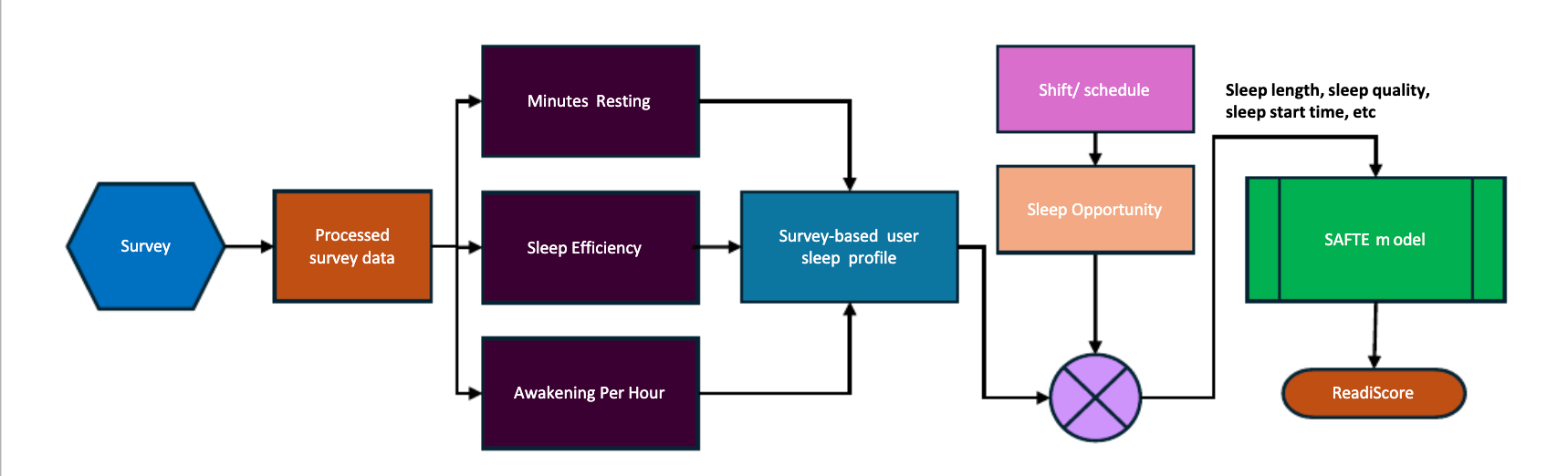
From these surveys, researchers engineered sleep-related features to estimate three key sleep profile parameters required by the SAFTE™ model:
- Minutes Resting
- Sleep Efficiency
- Awakenings Per Hour
To estimate these parameters, the study implemented 2-dimensional convolutional neural network (2D-CNN) models, trained and validated using wearable-derived sleep data as ground truth. The predicted sleep parameters were then passed into the SAFTE™ model to generate survey-based ReadiScores.
Key Findings
The study found that:
- Survey-based deep learning models were able to predict sleep parameters that closely matched wearable-derived values
- ReadiScores generated using survey-based sleep profiles showed high correlation with ReadiScores generated from wearable data
- The survey-based approach achieved sensitivity above 90%, false positive rates below 17%, and mean absolute error below 10 when compared to wearable-based ReadiScores
- Cross-trial and 30-fold cross-validation testing demonstrated consistent performance and reliability
These results indicate that a software-only, non-wearable approach can provide fatigue predictions comparable to those produced using wearable sleep tracking, within the study population.
Implications for Safety-Sensitive Workforces
The paper concluded that survey-based fatigue modeling is a viable complementary solution when wearable sleep data are unavailable due to non-compliance, device absence, or operational constraints. The authors note that this approach allows fatigue forecasting to continue using the SAFTE™ model even in the absence of sensor data.
While the study focused on mining workers, the authors state that the methodology may be applicable to other safety-sensitive, shift-based industries.
About the Study
The research evaluated a non-wearable alternative to fatigue prediction using:
- Survey-derived sleep profiles
- Deep learning models (CNN)
- The SAFTE™ biomathematical fatigue model
- Comparison against wearable-based ReadiWatch sleep data
The survey-based model has been deployed operationally for more than one year with non-wearable or non-compliant users, as reported in the study.
To learn more about survey-based and wearable fatigue prediction using the SAFTE™ model and ReadiScore, visit: www.fatiguescience.com
Media Contact:
Sunny Sung
VP, Marketing
Fatigue Science
marketing@fatiguescience.com
+1 (604) 408 0085