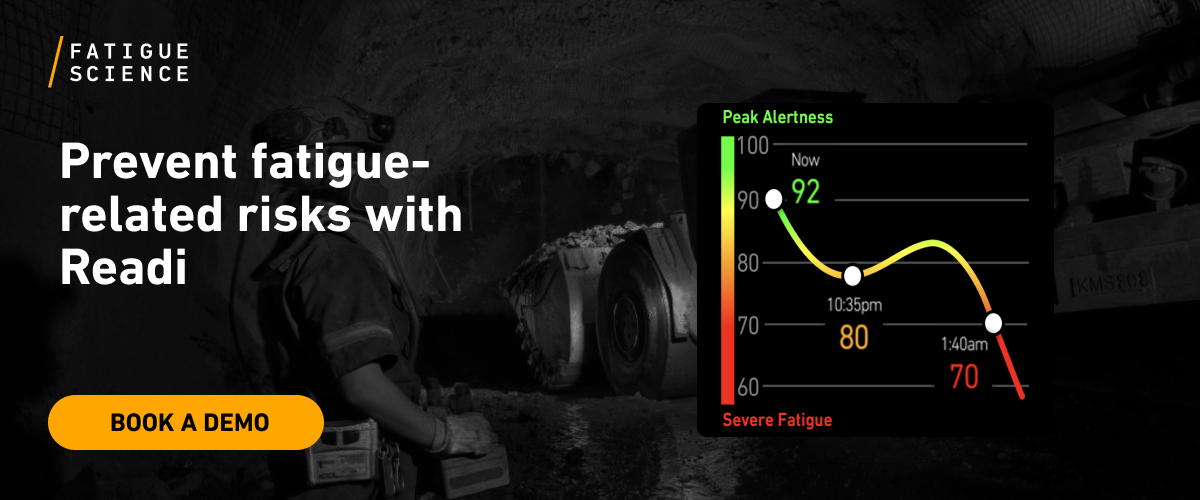



Canadian ELD fatigue management software should help teams connect duty records with a practical process for reviewing fatigue exposure and planning supervisor action.
See how Readi connects ELD data with personalized fatigue prediction
Key Takeaways
- Compare compliance, integration, fatigue insight, and workflow separately.
- Check current Canadian certification and jurisdictional requirements.
- Use a scorecard and pilot to assess fit.
- Readi provides predictive fatigue insight alongside ELD systems.
What the software should do
Federally regulated carriers must use ELDs that meet applicable Canadian requirements, subject to defined exceptions. Transport Canada explains the ELD requirements for commercial drivers and motor carriers. ELD records support HOS compliance, but do not show whether a driver slept during off-duty time or is fully alert.
Fatigue software adds another layer: it helps fleets examine work-rest history, schedule timing, and operating risk. The right choice depends on routes, systems, policies, and supervisor workflows.
Compare the main solution types
ELD and compliance platforms
These tools focus on duty-status records, HOS compliance, inspections, and fleet administration. They are essential for applicable carriers, but a compliance view alone may not identify sleep-related or circadian risk.
Telematics and in-cab safety tools
Telematics and camera systems can surface driving events and reviewable footage. They help teams understand what happened on the road, but are generally strongest at showing events after a risk becomes visible.
Predictive fatigue management
Predictive tools analyze schedule and sleep-related patterns to help estimate fatigue risk before work begins. Evaluate how the model works, what data it uses, how supervisors receive the result, and whether the system fits existing workflows. Readi is one option in this category; review its fatigue management system, ELD integrations, and driver fatigue management technology.
Questions to ask vendors
- Does it connect to our ELDs? Confirm supported providers, data fields, refresh timing, and exception handling.
- Does it assess risk before dispatch? Ask whether it is predictive or reports past events, and request a clear explanation of inputs and limits.
- Can supervisors act on the information? Look for an actionable exception view, response documentation, and useful reporting.
- How does it handle privacy? Ask what data is collected, who can see it, how long it is retained, and whether wearables or extra hardware are required.
- How will we measure value? Define a pilot around routes or shifts with clear exposure. Track adoption, response time, safety indicators, and operating fit.
The Readi overview brochure and EHS buyer’s guide to fatigue risk management software can help frame an evaluation.
Plan implementation around Canadian operations
Map cross-border routes, provincial jurisdictions, overnight lanes, seasonal peaks, and dispatch practices. Confirm which regulations apply and keep compliance review separate from fatigue-risk assessment. Train dispatchers and drivers on program purpose, privacy, and escalation. Start with a focused pilot, then adjust the workflow before expanding.
Where Readi fits in a Canadian ELD strategy
ELD requirements and operating rules vary by jurisdiction, so Canadian carriers should confirm which federal or provincial requirements apply to their operations. ELD systems help record duty status; Readi by Fatigue Science addresses a different question by forecasting personalized fatigue risk across an upcoming shift. Used together, the tools can help a team consider both recorded work patterns and forward-looking fatigue exposure.
When comparing software, ask how data moves between systems, how supervisors receive and act on insights, what drivers are told, and how privacy and access are managed. Readi integrates with major ELD platforms, but technology should support a defined policy and human review. Review the ELD integrations overview and Readi buyer’s guide.
Evaluate vendors against operational needs
Compare platforms using the workflows your team must support, rather than a feature checklist alone. Confirm which ELD providers are supported, what data is exchanged, how quickly it updates, and what happens when a connection is interrupted. Ask to see how a dispatcher reviews an upcoming shift, what information a supervisor can access, and how an action is recorded. Include driver communication, privacy controls, training effort, implementation support, and reporting in the evaluation. Request a pilot plan with clear success measures and named owners. Revisit the requirements with safety, operations, IT, and drivers so the selected system fits how work is actually planned. A tool is only useful if the people who need it can interpret the information and act consistently.
Canadian ELD fatigue management software: evaluate Canadian tools with a decision matrix
Canadian ELD fatigue management software: practical steps and decision criteria
For Canadian ELD fatigue management software, use the steps and review criteria in this guide to connect recorded work patterns, operational context, and fatigue prevention. Readi by Fatigue Science contributes a personalized forecast for the upcoming shift where deployed, supporting a contextual review by authorized supervisors.
Check certification, integration, and fatigue capability separately
For Canadian operations, distinguish a compliant ELD from a fatigue management platform. Transport Canada explains that federally regulated carriers must use devices meeting the applicable requirements; confirm current rules and certification status for your operation. An ELD records duty information, while fatigue management capabilities may add education, schedule analysis, or predictive insight. Ask vendors to demonstrate each capability rather than treating them as interchangeable.
Evaluate how a system handles Canadian routes, cross-border work, time zones, language needs, connectivity, and data permissions. Ask what source data is used, how often it refreshes, how supervisors see an exception, and what happens when information is missing. Transport Canada ELD guidance and its trucking fatigue management resource are useful starting points. Check provincial rules and your own legal advice where relevant.
Copy-and-use vendor scorecard
| Evaluation area | Question to ask | Evidence to request |
|---|---|---|
| ELD compliance | Does the device meet the rules for our operation? | Certification and supported use cases |
| Integration | Which systems and fields connect? | Data map, refresh timing, outage process |
| Fatigue insight | Does it show history, forecast, or both? | Live workflow demonstration |
| Supervisor action | What does a user do with a concern? | Escalation and action log |
| Privacy and rollout | Who sees data and how are users trained? | Permissions, retention, implementation plan |
Score each area against agreed requirements, then test the highest-priority workflow in a pilot. Readi by Fatigue Science adds predictive fatigue risk insight and can complement ELD and telematics tools; it is not an ELD compliance product. Confirm integration fit and the intended use with your vendor team.
Sources and further reading
Written by Fatigue Science, a provider of predictive fatigue risk management technology for fleet and industrial teams. Last updated: November 24, 2026.
Canadian ELD fatigue management software: practical review and action
Canadian ELD fatigue management software in day-to-day fleet operations
Begin by writing down the question the team needs to answer. vendor selection should help identify a repeatable condition, not label an individual. Use a consistent review period and group records by comparable route, start time, terminal, and work sequence. Confirm that data are complete and that timestamps align before drawing comparisons. Ask drivers and dispatchers what shaped the work: a carrier operating both domestic and cross-border routes. Record this context with the evidence so another reviewer can understand how the team reached its decision.
A practical process distinguishes what the record shows from what it cannot show. An ELD documents duty status and driving history; it does not confirm sleep quality, alertness, or causation. Readi by Fatigue Science adds a personalized fatigue forecast across the upcoming shift where deployed. Together, ELD data and Readi can support a more complete planning discussion, with human review and company policy guiding each action. Keep access limited to authorized roles, explain how information is used, and give drivers a way to correct an inaccurate record or provide context.
| Review element | What to check | Possible next step |
|---|---|---|
| Work pattern | Canadian certification fit, integration, fatigue function, privacy, and rollout support | Confirm whether the pattern repeats across comparable shifts. |
| Operating context | a carrier operating both domestic and cross-border routes | Discuss with the driver and operations before drawing a conclusion. |
| Forward planning | Upcoming schedule, forecast timing, route demands, and available response options. | Use Readi by Fatigue Science’s personalized fatigue forecast for an upcoming shift alongside ELD history, route conditions, telematics, and driver input. Readi can help authorized supervisors focus a planning conversation on the timing of potential fatigue exposure. It is a decision-support signal, not a diagnosis, a guarantee of alertness, or a replacement for compliance checks and safe driving judgment. |
Copy-and-use review checklist
- Define: write the question, period, and operating group being reviewed.
- Verify: confirm the data are complete and comparable.
- Contextualize: check route, schedule, delays, and driver input.
- Decide: identify an owner and a policy-approved action.
- Document: record the evidence, decision, and follow-up date.
- Learn: review whether the pattern recurs and whether the control helped.
Use the checklist for prevention and continuous improvement, not automatic discipline. If the same condition affects several drivers, examine dispatch practices, route assumptions, staffing, or customer requirements. If the issue is isolated, confirm that the record is accurate and provide coaching or support suited to the circumstances. Use Readi by Fatigue Science’s personalized fatigue forecast for an upcoming shift alongside ELD history, route conditions, telematics, and driver input. Readi can help authorized supervisors focus a planning conversation on the timing of potential fatigue exposure. It is a decision-support signal, not a diagnosis, a guarantee of alertness, or a replacement for compliance checks and safe driving judgment.
Example: Score required capabilities separately and validate each in a pilot.
For example, if a review surfaces a carrier operating both domestic and cross-border routes, compare similar work periods, ask the people involved what changed, and identify whether a scheduling or process adjustment is possible. Set a time to check whether the new approach was followed and whether the pattern returned. Readi can help teams consider personalized fatigue risk timing before a shift, while ELD records describe prior duty patterns. Use the two sources as complementary context; neither replaces the driver’s report, applicable HOS rules, or a supervisor’s judgment.
Frequently asked questions
Does an ELD measure driver fatigue?
No. It records duty-related information to support compliance. Fatigue assessment requires additional context and methods.
What is the difference between ELD and fatigue management software?
ELD software records duty status and supports compliance. Fatigue software adds analysis and workflows intended to help teams assess exposure.
How should fleets compare vendors?
Check integration, predictive capability, explainability, privacy, usability, and how outcomes will be measured in a pilot.