
Product News
Fleet Management


Reefer driver fatigue is a significant safety and operational concern in refrigerated trucking, where strict delivery windows, overnight driving, and irregular schedules create conditions that increase fatigue risk factors beyond what many other freight segments face. Understanding these risks and applying preventative fatigue strategies is essential for protecting drivers, cargo, and the public.
Reefer trucking safety depends on recognizing that temperature-controlled freight introduces fatigue pressures that standard dry van operations do not. Perishable goods like food and pharmaceuticals require on-time delivery within narrow windows. This means reefer driver schedules often include overnight runs, early-morning dock appointments, and multi-stop routes that fragment rest opportunities and disrupt circadian rhythms.
Several factors make long-haul driver fatigue especially common in reefer operations:
These conditions mean that reefer driver fatigue is not simply a matter of too many hours behind the wheel. It is a product of when those hours occur, how sleep is structured around them, and how much physical work happens between driving segments. Fatigue symptoms in truck drivers under these conditions include slower reaction times, impaired judgment, lane drift, and microsleeps, all of which contribute directly to fatigue-related incidents.
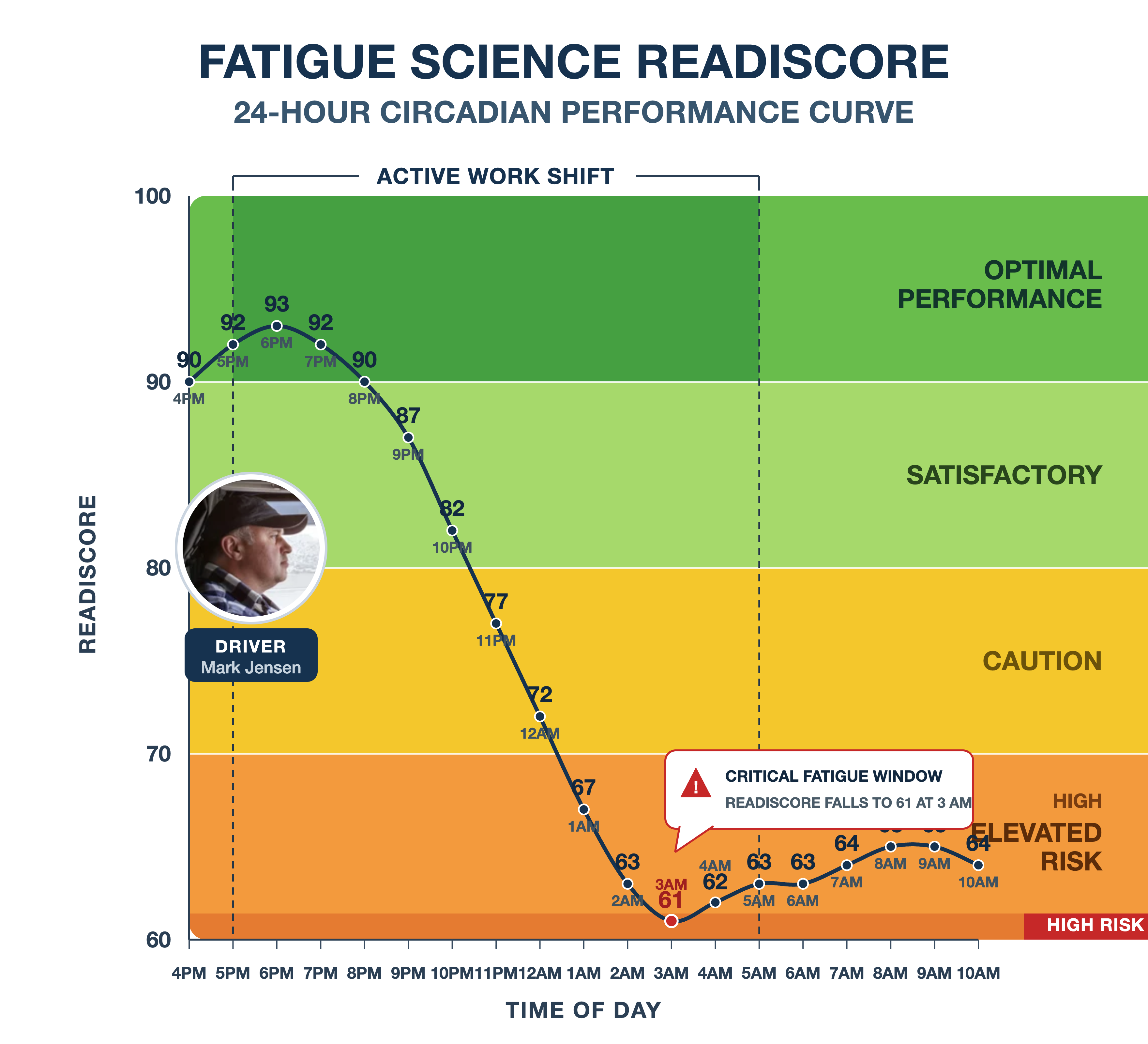
Sleep management for drivers in reefer operations requires more than compliance with hours-of-service rules. HOS regulations set maximum driving limits but do not account for individual sleep quality, circadian timing, or cumulative sleep debt. A driver can be fully HOS-compliant and still operate at significantly reduced alertness. This gap between compliance and actual fitness is where driver fatigue management programs become critical. Predictive fatigue management tools like Readi can forecast fatigue risk up to 18 hours in advance by analyzing sleep and schedule data without requiring wearables, giving fleet safety teams an earlier signal than reactive camera alerts or post-event reviews alone.
Effective reefer driver fatigue management treats fatigue as an operational risk that connects safety outcomes, fuel costs, cargo integrity, and driver retention, not just a wellness topic or a box to check during orientation.
Reefer driver fatigue drops when fleets treat fatigue control as part of trip planning, not only as a response to a crash, camera clip, or HOS exception. The most useful steps are practical ones that fit daily reefer truck operations and address risk before a route enters a low-alertness window.
Pre-shift prevention depends on four inputs that work together: sleep science, dispatch timing, HOS records, and leading indicators from ELDs, telematics, and fatigue management software. When those inputs sit in one workflow, supervisors can spot high-exposure routes early and make smaller changes with less disruption.
The first step is to review reefer driver schedules as exposure data. A driver may have legal hours left and still face a poor setup for alertness because of short daytime sleep after a night run, a late receiver release, or a start time that falls in the early morning dip in human performance.
A solid driver fatigue management process focuses on exceptions with stacked fatigue risk factors. Reefer trucking safety improves when dispatch, safety, and operations teams review the loads most likely to create long-haul driver fatigue instead of applying the same response to every lane.
Most fleets already collect the raw inputs needed for better fatigue control. ELDs show off-duty windows and start-time swings; telematics show harsh braking, speed volatility, and other event patterns; cameras help confirm what took place after a lapse in attention. Each tool is useful, but none of them gives a full view on its own.
Readi adds a predictive view that supports daily supervisor decisions. It provides on-demand visibility into fatigue risk and workforce performance, supports decisions on resource allocation, task planning, worker training, and scheduling, and helps teams see elevated risk 18 hours in advance without wearables or added hardware.
In reefer truck operations, fatigue risk often grows out of appointment volatility. A driver may wait half a shift for a trailer, leave the shipper late, and still face a narrow unload window before sunrise; the result is a broken sleep pattern and too little time for solid recovery.
Cold-chain freight adds a form of schedule pressure that standard van freight does not always carry. When produce, dairy, meat, or pharmaceuticals have little timing slack, drivers may start work after poor sleep, stay awake through detention, or accept another dispatch before the body has recovered from the last run.
Another fatigue risk factor in reefer trucking safety comes from the driving environment itself. Long interstate stretches with steady speed, cruise control use, and few traffic changes can mask early fatigue symptoms in truck drivers; the first clues may show up as slower mirror checks, missed road signs, late lane choices, or difficulty recalling the last few exits.
General freight often allows more room to absorb a delay. Reefer truck operations often pair quiet road hours with hard appointment pressure, which means a driver can stay in motion during a period of falling alertness and not notice the decline until performance slips.
A fatigued reefer driver rarely shifts from alert to unsafe in one step. The change usually starts with small misses during ordinary highway work, especially on long refrigerated runs where low traffic, steady engine noise, and limited stimulation can hide a drop in alertness.
Several fatigue symptoms in truck drivers show up before a reportable safety event. In reefer truck operations, the most useful clues include:
Microsleeps create the highest risk because they can last only a few seconds and still cover hundreds of feet at highway speed. On reefer routes, that risk often rises on long interstate segments where the task feels steady and the driver has few changes in scenery, traffic, or road demand to help maintain alertness.
Drivers, dispatchers, and safety leaders should track patterns instead of one isolated moment. A single yawn means little by itself; repeated memory gaps, slower responses, and irritability across several dispatch cycles can point to accumulated long-haul driver fatigue. ELD records, telematics safety events, and route timing can help show whether certain reefer driver schedules produce the same low-alertness pattern again and again.
Dash cams and post-event video review still have value, but they usually enter the picture after performance has already slipped. Strong driver fatigue management in reefer trucking safety depends on earlier recognition of these behavioral cues, before a lane correction, hard brake, or near miss turns a fatigue issue into an operational problem.
Reefer driver schedules look compliant on paper more often than they look workable in real life. An ELD may show a full off-duty period, yet part of that block can disappear into receiver delays, fuel, trailer checks, paperwork, meals, and the time it takes to settle into sleep after a late unload. For driver fatigue management, the question is not only how many hours sit between duty periods, but how much of that time can support real sleep.
Dispatch planning should protect the sleep window that comes before the hardest part of the run. That includes overnight departures, pre-dawn pickups, and multi-stop refrigerated routes with fixed appointment chains. A driver who finishes a daytime route and then flips to a 1 a.m. start two days later may stay legal under HOS and still carry long-haul driver fatigue into the next trip. The same problem shows up when off-duty time gets chopped up by load updates, gate queues, or last-minute route changes.
Fleets usually find the same schedule traps again and again when they review reefer truck operations with ELD data and route timing:
Many fleets make better progress on reducing driver fatigue when they manage these exceptions instead of treating every load the same. A broad rule across the whole operation tends to waste capacity on low-risk lanes and miss the routes that produce repeated high-fatigue starts. A more useful approach sorts lanes by timing volatility, detention history, and recovery quality, then gives dispatchers a short list of loads that need extra control.
Tools such as Readi help supervisors pull together schedule data, rest patterns, and operating signals so they can spot elevated risk 18 hours in advance. That gives safety and operations teams time to adjust a dispatch plan, shift an appointment, or reassign a run while options still exist.
In reefer truck operations, sleep control starts with a protected anchor rest window between dispatches. A driver who goes to sleep at roughly the same time after each similar route usually shows better alertness than a driver whose rest time shifts with every load update.
Daytime sleep after an overnight lane is often shorter and lighter than sleep taken at night because sunlight, family activity, truck stop noise, and warm cab temperatures break sleep into smaller blocks. That pattern leaves many drivers with less recovery than the off-duty record suggests, especially after a receiver delay pushes rest into late morning or afternoon.
Sleep management for drivers also needs a plan for the hours between wake-up and departure. Yard moves, check-ins, and last-minute appointment changes can chip away at alertness before the route even begins, which is one reason long-haul driver fatigue can build across a full week of reefer work.
A strong driver fatigue management process reviews these patterns across several runs, since reefer loads often bring repeat delays at the same shippers and receivers. That review helps fleets spot lanes with poor daytime recovery, drivers with repeated sleep disruption, and schedule patterns that raise reefer driver fatigue before fatigue-related incidents show up on the road.
Hours-of-service rules give reefer fleets a legal framework for basic fatigue control. In U.S. trucking, that framework includes an 11-hour driving limit after 10 hours off duty, a required 30-minute break after 8 hours of consecutive driving, and a 60/70-hour cap across 7 or 8 days. Those limits reduce extreme overwork, but they do not show whether a driver reached the sleeper at the right time, slept well, or carried sleep debt into a time-sensitive route.
ELDs give fleets a clean record of drive time, on-duty time, break timing, and rest periods. That visibility helps dispatch and safety teams spot schedule pressure, detention impact, and route plans that leave little room for recovery. ELDs still cannot tell a supervisor whether a driver feels heavy-eyed at 4:30 a.m. after a poor daytime sleep period or whether a legal restart came with fragmented rest in a noisy truck stop.
A stronger driver fatigue management process looks for patterns that show risk before a violation, near miss, or crash:
These indicators help fleets separate ordinary route variation from recurring fatigue exposure in reefer truck operations. A dispatcher can see that one lane produces repeated dawn arrivals after long wait times at the shipper, while another lane produces clean logs and stable performance. That level of detail supports better route timing, better exception handling, and better supervisor decisions than compliance data alone.
Readi adds an earlier layer of visibility for teams that already use ELDs, cameras, and telematics. It helps supervisors identify elevated fatigue risk 18 hours in advance and supports decisions on resource allocation, task planning, worker training, and scheduling, which gives reefer trucking safety programs a clearer view of where fatigue-related incidents are most likely to start.
Reefer driver fatigue does not sit with the driver alone. Dispatchers, safety leaders, and operations managers all influence risk through appointment changes, repowers, dock sequencing, and delay handling across reefer truck operations.
Dispatcher coaching should center on the conditions that cut into real rest. Warehouse delays, backhaul changes, long check-in lines, and disrupted sleeper-berth breaks can leave a driver with available drive time on paper but poor alertness for the next leg. Strong driver fatigue management asks dispatchers to review the full duty picture before they protect service on a temperature-sensitive load.
Supervisor coaching should rely on sequence, timing, and operating context rather than blame. A missed turn, a late response in traffic, or a rough approach into a distribution yard should trigger a review of receiver delays, load timing, time awake, and route design; that review gives fleets a better way to address long-haul driver fatigue than another generic safety reminder.
Reefer trucking safety improves when teams make the safer call before a minor issue grows into a serious event. In practice, that may mean holding a load at the shipper, shifting the delivery order, or moving the final leg to another driver after a disrupted rest period. Readi supports those decisions with on-demand visibility into fatigue risk and performance, which helps supervisors with scheduling, worker training, task planning, and resource allocation.
Most fleets already use cameras, telematics, and ELDs to track driving behavior, duty status, and compliance. Those systems help document what took place on a route, but they do not give dispatchers a clear view of which load plan may carry elevated reefer driver fatigue risk before the truck reaches the receiver, the weather corridor, or the final leg of a long-haul run.
A predictive step closes that gap. Instead of waiting for a harsh braking clip, a lane event, or a pattern of missed turns, fleets can review fatigue exposure tied to route timing, detention history, prior duty cycles, and recent rest opportunity before dispatch releases the trip.
This approach fits the tools fleets already own. A platform such as Readi can pull together data that managers already collect across operations and turn it into on-demand visibility for resource allocation, task planning, worker training, and scheduling, which supports more practical decisions across reefer truck operations without adding another manual review step.
The result is a safety program that works with more precision. Coaching time shifts toward routes and schedules that need intervention, dispatch gains a better way to reduce surprise fatigue problems mid-trip, and reefer trucking safety improves through earlier decisions rather than a larger backlog of alerts.
In reefer truck operations, fatigue often shows up in task quality before a major driving error appears. Common warning signs include missed road signs, uneven speed on long interstate stretches, repeated steering corrections, trouble with simple dock instructions, forgotten temperature check steps, and poor recall of the last hour of the trip.
A workable plan starts before the load leaves the yard. Reefer drivers usually do better when they protect one solid sleep period before departure, keep meal timing steady, and alert dispatch early when weather, detention, or receiver delays cut into rest.
Reefer carriers follow the same federal hours-of-service rules as other property-carrying commercial fleets. Key limits include up to 11 hours of driving after 10 consecutive hours off duty, no driving after the 14th on-duty hour, a 30-minute break after 8 hours of driving, and a 60 or 70-hour cap over 7 or 8 days. ELDs track those duty periods and support compliance reviews.
Driver fatigue management affects more than crash prevention in refrigerated freight. A tired reefer driver may brake hard into slow traffic, misjudge space in a crowded yard, miss a turn and add detention time, or make poor choices in rain, fog, or ice. Those errors can lead to injury, equipment damage, missed appointments, product loss, and higher operating cost.
Reefer driver schedules often shift by several hours from one run to the next, which makes sleep harder to plan and harder to maintain. A late-night pickup, followed by a predawn receiver appointment and a long wait at a cold storage dock, can leave a driver with legal off-duty time but no stable sleep routine. Fatigue risk usually rises when start times move back and forth, when detention pushes rest into daylight, and when turnaround time between trips stays short.
Reefer fleets that already invest in cameras, telematics, and ELD compliance have the raw data to manage fatigue more precisely. The missing piece for most operations is a way to connect that data to daily dispatch and supervisor decisions before a driver reaches a high-risk segment of the route. Readi forecasts fatigue risk up to 18 hours in advance, requires no wearables or added hardware, and fits into the workflows safety and operations teams already use.
Book a demo to explore how predictive fatigue management software can improve safety and productivity across your reefer fleet.
Five common signs of driver fatigue include frequent yawning, heavy or sore eyes, drifting attention with missed mirror checks, slower braking response times, and trouble recalling the last few miles of the route. In reefer operations, these symptoms often appear during long interstate stretches with low traffic and steady engine noise.
Driver fatigue drops when fleets protect one solid sleep period before overnight or early-morning routes, keep start times consistent across similar loads, and stop work when alertness declines rather than pushing through to meet an appointment. Short naps during planned stops can reset attention during long hauls.
The 7/3 split sleeper berth provision allows drivers to divide the required 10-hour off-duty period into a 7-hour rest segment and a 3-hour rest segment, which can help manage fatigue on multi-stop reefer routes. This split does not extend the 14-hour on-duty window but can provide flexibility when detention or appointment timing disrupts a single long rest period.
CDL drivers show fatigue through missed road signs, uneven speed control on highways, repeated steering corrections, irritability at routine delays, and poor recall of recent route segments. In reefer trucking, these warnings often appear before a camera event or safety incident, especially during the 2:00 a.m. to 6:00 a.m. circadian low.