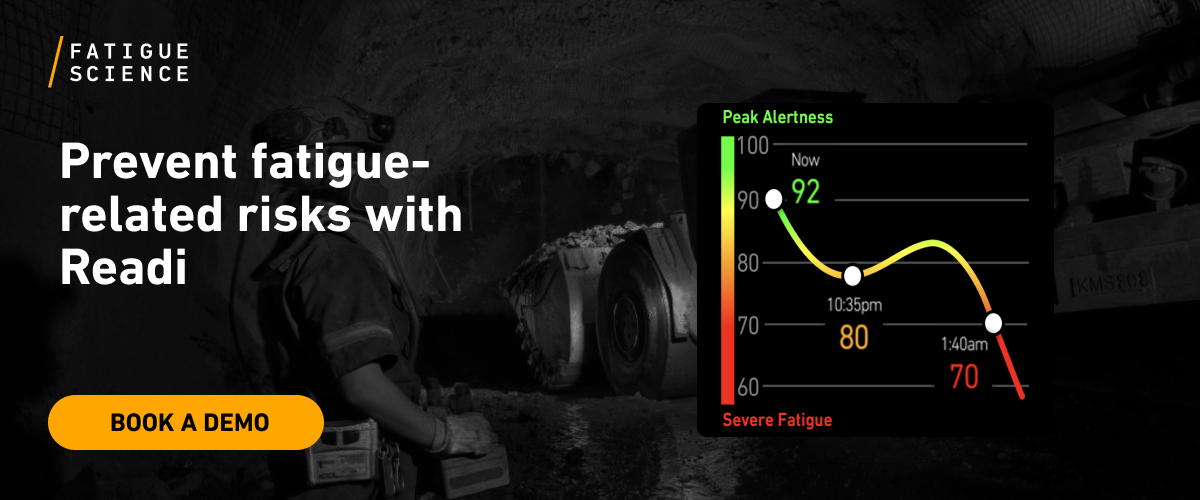



Commercial fleet fatigue monitoring with ELD integration connects duty history with operational context so teams can review demanding schedules and plan response.
See how Readi connects ELD data with personalized fatigue prediction
Key Takeaways
- Define a single monitoring workflow across ELD, telematics, and fatigue tools.
- Verify context before action and record follow-up.
- Review repeated patterns for system-level fixes.
- Readi forecasts fatigue risk for an upcoming shift.
Use ELD data for more than compliance
ELDs support hours-of-service recordkeeping, but a compliant log does not confirm that a driver slept well or is alert. Start with duty timing, overnight work, repeated long shifts, short recovery opportunities, and changing start times. Consult applicable rules, including the FMCSA HOS overview for U.S. operations.
Find patterns across routes and shifts
Review data across several days and segment it by terminal, route, customer, and start time. Look for delay-heavy routes, repeated overnight work, or schedules that leave little room for recovery. Include driver and dispatcher feedback so the numbers have context.
Where available and permitted, compare ELD patterns with telematics safety events or camera reviews. A cluster may point to a schedule or route worth investigating, but it does not prove fatigue caused an event.
Turn findings into action
Define a process for reviewing patterns and assigning next steps. Dispatch may adjust an assignment or start time; supervisors may discuss repeat issues; safety leaders may revise policy. Keep records focused on evidence and actions taken.
A fatigue risk management system can connect these decisions with policy and accountability. ELD integrations can bring duty history into existing workflows, while driver fatigue management technology may add a predictive view.
Support decisions with clear measures
Choose a few indicators: recurring schedules that trigger review, response completion, route or shift changes, and relevant safety-event trends. Review them with operations and dispatch. If the same pattern appears repeatedly, look for systemic causes such as detention, staffing, or unrealistic delivery windows.
Share the process with drivers. Explain what information is collected, who can access it, and how they can report fatigue. A fatigue policy for trucking fleets can make expectations clear. Teams evaluating tools can refer to the EHS buyer’s guide.
Combine ELD history with Readi’s forecast
ELD data helps teams understand duty and rest patterns that have already occurred. Readi by Fatigue Science adds a forward-looking forecast of personalized fatigue risk during an upcoming shift. Together, these sources can help managers consider schedule history and future exposure in the same planning process.
For example, a supervisor may review an overnight assignment, consider the driver’s schedule context and available forecast, and consult dispatch about timing or other options under policy. Readi does not determine fitness for duty or replace HOS review. Use it as decision support, with clear human ownership and driver communication. See ELD integration options.
Turn ELD review into a practical routine
Choose a review cadence that matches how often schedules change. A weekly review may help identify repeated patterns, while a pre-shift review can address a specific demanding assignment. Define the information a supervisor should consider, including duty history, start time, route, expected delays, and driver input. Make the escalation path clear when concerns arise, and document which option was selected. Periodically sample completed reviews to see whether the process is consistent across terminals and shifts. If teams are reviewing too many low-value exceptions, refine the rules. If important patterns are missed, revisit the data or thresholds. This keeps analysis useful and prevents reports from becoming a compliance-only exercise.
commercial fleet fatigue monitoring with ELD integration: a monitoring workflow with ELD context
commercial fleet fatigue monitoring with ELD integration: practical steps and decision criteria
For commercial fleet fatigue monitoring with ELD integration, use the steps and review criteria in this guide to connect recorded work patterns, operational context, and fatigue prevention. Readi by Fatigue Science contributes a personalized forecast for the upcoming shift where deployed, supporting a contextual review by authorized supervisors.
Connect retrospective records and forward planning
ELD data helps reconstruct duty history, while telematics and camera systems can help teams review events on the road. A fatigue management platform can add a different perspective by forecasting risk before or during an upcoming shift. The value comes from connecting these sources to an agreed workflow. Determine who reviews which signal, what additional context is needed, and which actions are permitted. Avoid sending every exception to every user; define thresholds that help teams focus on patterns and decisions they can influence.
Document what each system measures and what it cannot establish. Repeated events can trigger a review but do not prove fatigue causation. Talk with drivers and dispatchers, check route and schedule conditions, and consider alternative explanations. See FMCSA HOS guidance and NIOSH driver fatigue resources for background.
Copy-and-use monitoring workflow checklist
- Receive: note the source, timestamp, and data quality.
- Verify: check the record and compare relevant route or schedule context.
- Discuss: ask the driver or dispatcher what was happening.
- Decide: choose a policy-approved next step and assign an owner.
- Record: document the reason, action, and follow-up date.
- Learn: look for repeated patterns and adjust operations when warranted.
Readi by Fatigue Science can contribute an individualized fatigue forecast for the shift, supporting a review before a potential exposure window. Keep human ownership, privacy controls, and driver communication explicit in the workflow.
Sources and further reading
Written by Fatigue Science, a provider of predictive fatigue risk management technology for fleet and industrial teams. Last updated: November 24, 2026.
commercial fleet fatigue monitoring with ELD integration: practical review and action
commercial fleet fatigue monitoring with ELD integration in day-to-day fleet operations
Begin by writing down the question the team needs to answer. fatigue monitoring should help identify a repeatable condition, not label an individual. Use a consistent review period and group records by comparable route, start time, terminal, and work sequence. Confirm that data are complete and that timestamps align before drawing comparisons. Ask drivers and dispatchers what shaped the work: a telematics event with a potentially demanding schedule beforehand. Record this context with the evidence so another reviewer can understand how the team reached its decision.
A practical process distinguishes what the record shows from what it cannot show. An ELD documents duty status and driving history; it does not confirm sleep quality, alertness, or causation. Readi by Fatigue Science adds a personalized fatigue forecast across the upcoming shift where deployed. Together, ELD data and Readi can support a more complete planning discussion, with human review and company policy guiding each action. Keep access limited to authorized roles, explain how information is used, and give drivers a way to correct an inaccurate record or provide context.
| Review element | What to check | Possible next step |
|---|---|---|
| Work pattern | which tool surfaces each signal, review timing, contextual checks, and response ownership | Confirm whether the pattern repeats across comparable shifts. |
| Operating context | a telematics event with a potentially demanding schedule beforehand | Discuss with the driver and operations before drawing a conclusion. |
| Forward planning | Upcoming schedule, forecast timing, route demands, and available response options. | Use Readi by Fatigue Science’s personalized fatigue forecast for an upcoming shift alongside ELD history, route conditions, telematics, and driver input. Readi can help authorized supervisors focus a planning conversation on the timing of potential fatigue exposure. It is a decision-support signal, not a diagnosis, a guarantee of alertness, or a replacement for compliance checks and safe driving judgment. |
Copy-and-use review checklist
- Define: write the question, period, and operating group being reviewed.
- Verify: confirm the data are complete and comparable.
- Contextualize: check route, schedule, delays, and driver input.
- Decide: identify an owner and a policy-approved action.
- Document: record the evidence, decision, and follow-up date.
- Learn: review whether the pattern recurs and whether the control helped.
Use the checklist for prevention and continuous improvement, not automatic discipline. If the same condition affects several drivers, examine dispatch practices, route assumptions, staffing, or customer requirements. If the issue is isolated, confirm that the record is accurate and provide coaching or support suited to the circumstances. Use Readi by Fatigue Science’s personalized fatigue forecast for an upcoming shift alongside ELD history, route conditions, telematics, and driver input. Readi can help authorized supervisors focus a planning conversation on the timing of potential fatigue exposure. It is a decision-support signal, not a diagnosis, a guarantee of alertness, or a replacement for compliance checks and safe driving judgment.
Example: Make the workflow actionable and avoid sending users unprioritized alerts.
For example, if a review surfaces a telematics event with a potentially demanding schedule beforehand, compare similar work periods, ask the people involved what changed, and identify whether a scheduling or process adjustment is possible. Set a time to check whether the new approach was followed and whether the pattern returned. Readi can help teams consider personalized fatigue risk timing before a shift, while ELD records describe prior duty patterns. Use the two sources as complementary context; neither replaces the driver’s report, applicable HOS rules, or a supervisor’s judgment.
Frequently asked questions
Can ELD data predict fatigue by itself?
No. It documents duty patterns. A predictive assessment requires additional methods and careful interpretation.
What should a fleet review first?
Start with overnight work, changing start times, repeated long days, and limited recovery opportunities.
How do we avoid alert overload?
Prioritize a small number of actionable signals, define response ownership, and refine rules using operational feedback.