
Product News


Insurance premiums in trucking are on the rise, driven by nuclear verdicts, regulatory scrutiny, and rising claims costs. But amid this volatility, a new opportunity is emerging: the ability to use AI and telematics data to demonstrate proactive risk management. This article explores how the insurance landscape is changing, how technologies like Readi provide valuable operational insights, and what forward-thinking fleets are doing to prepare for the future.
Fleet insurance AI refers to the use of artificial intelligence, telematics, ELD data, dashcam data, driver behavior trends, and predictive safety models to better understand fleet risk.
For trucking and logistics companies, the value is practical. AI can help safety, operations, and risk teams identify leading indicators before they become claims. These may include fatigue risk, speeding trends, harsh braking, distraction alerts, coaching history, maintenance patterns, and route-level risk.
For insurers and brokers, this data can help separate fleets that are actively managing risk from fleets that only report incidents after they happen.
Readi Integrates with All Major ELDs. Learn More.
Fleet insurance remains under pressure in 2026, even as some parts of the broader commercial insurance market have softened.
Marsh reported that global commercial insurance rates declined 5% in Q1 2026, marking the seventh consecutive quarter of global rate decreases. Casualty was the outlier, with casualty rates up 3% globally and 9% in the U.S., driven by claims severity and excess-layer pressure.
For transportation companies, that distinction matters. A better overall insurance market does not automatically translate into easier fleet renewals.
In trucking and transportation, underwriters are still focused on:
ATRI’s 2025 litigation analysis found that tractor-trailer tort cases increased at an average annual rate of 3.7% from 2014 to 2023. It also reported that the median nuclear verdict reached $36 million in 2022, about 50% higher than the median in 2013.
CRC Group’s 2026 casualty market outlook also notes that commercial auto remains challenging, with nuclear verdicts affecting underwriting and pricing decisions. It also states that telematics data is increasingly required as part of the quoting process, especially in trucking.
The result is a more selective market. Clean loss runs still matter, but they are no longer the full story.
The biggest change for fleets is that underwriters are looking beyond historical claims.
Alliant’s 2026 Transportation Insurance Outlook says the affordability and availability of insurance will be determined by data transparency and the ability to use data in insurance costing. It also notes that underwriters are relying more on ELD data, telematics, camera analytics, and documented safety protocols to differentiate fleet risk.
That creates a new opportunity for fleets.
A fleet with the same loss history as another carrier may be viewed differently if it can show:
| Underwriter Question | Stronger 2026 Evidence |
|---|---|
| Are drivers being coached? | Coaching logs, event resolution notes, follow-up records |
| Are risky trends improving? | Month-over-month telematics and camera event trends |
| Are fatigue risks being managed? | Pre-shift fatigue forecasts, logged countermeasures, schedule adjustments |
| Are safety tools used consistently? | Adoption reports, supervisor usage, daily workflow documentation |
| Are incidents reviewed quickly? | Claims triage timelines, video review process, root cause analysis |
| Are high-risk drivers identified early? | Driver risk segmentation and proactive intervention history |
This is where fleet insurance AI becomes useful. It gives fleets a way to turn existing operational data into a clearer risk story.
Most fleets already have data. The problem is that the data is often spread across separate systems:
AI helps connect these signals and identify patterns that would be hard to see manually.
In fleet insurance, AI is being used to support:
| AI Use Case | What It Helps Fleets Show |
| Driver behavior analytics | Trends in speeding, harsh braking, following distance, distraction, and lane events |
| Predictive fatigue modeling | Risk windows before a shift or route begins |
| Claims triage | Faster review of video, incident data, and claim likelihood |
| Risk scoring | Which drivers, shifts, depots, or routes need attention |
| Coaching prioritization | Which events deserve intervention versus routine monitoring |
| Renewal documentation | Evidence that safety risks are reviewed, acted on, and tracked |
Hub International describes telematics as a shift from reactive insurance management to proactive risk management, with insurers increasingly using fleet data as evidence of safety performance.
Telematics and cameras are important, but they often detect risk after a behavior has already happened.
A dashcam can detect signs of distraction or drowsiness. A telematics platform can detect hard braking, speed, or lane movement. These tools are valuable, especially for incident review and driver coaching.
Fatigue is different because it often builds before a driver shows visible signs.
A driver may be technically compliant with hours-of-service rules and still have elevated fatigue risk due to:
That is why fatigue prediction is becoming more relevant to fleet insurance AI. It gives fleets a way to identify fatigue risk before dispatch, rather than waiting for a camera alert or safety event.
Readi from Fatigue Science is designed to help fleets predict and manage driver fatigue before it becomes an operational risk.
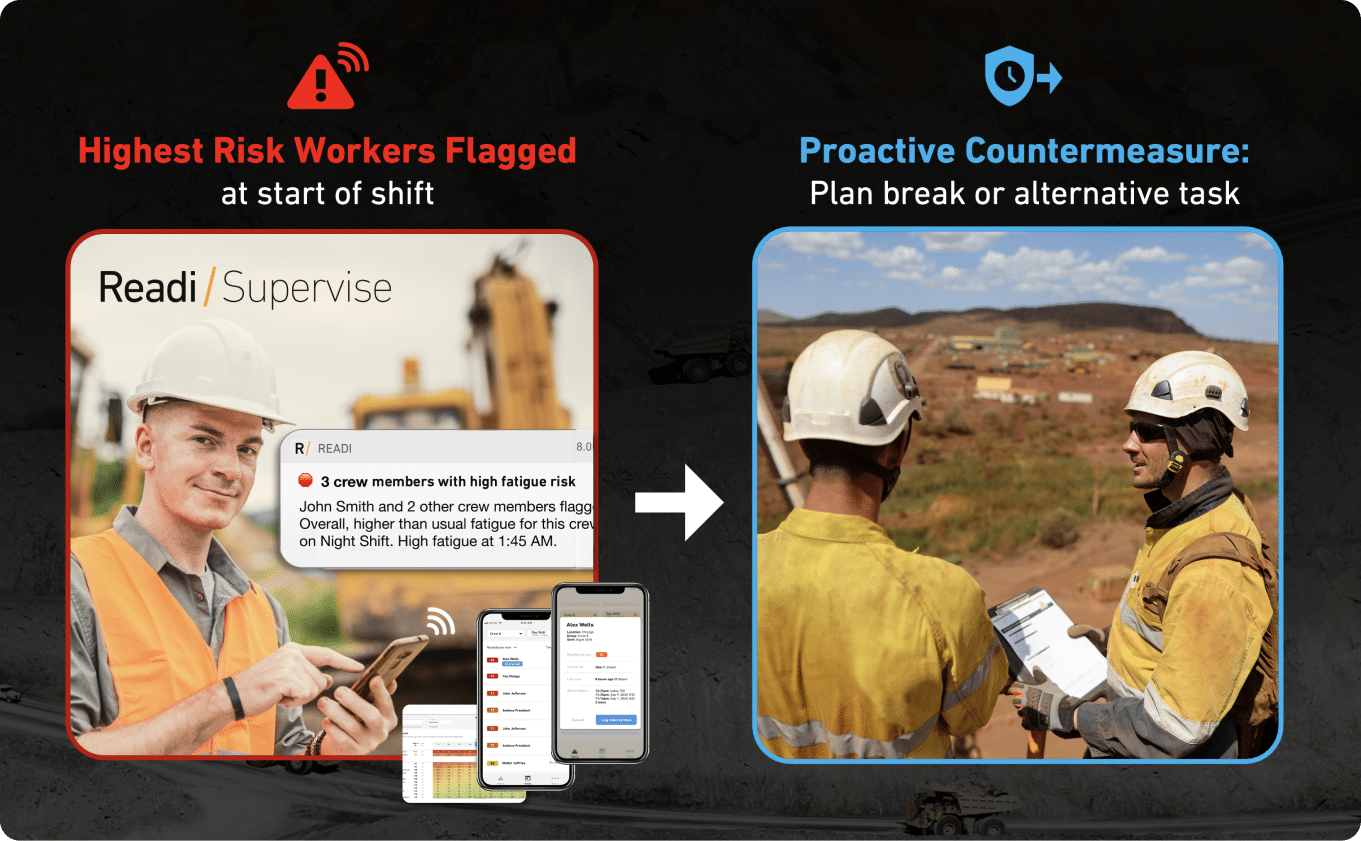
Readi uses fatigue science, machine learning, and schedule or ELD data to forecast individual fatigue risk before and during a shift. Fatigue Science states that Readi provides an individual hour-by-hour fatigue risk profile up to 18 hours before shift start.
Readi can be deployed as a software-only solution using ELD and schedule data, or with optional ReadiWatch wearables where appropriate. For fleets, the main value is that supervisors and dispatchers can see fatigue risk early enough to act.
Readi helps teams:
Readi has helped reduce fleet telematics events by 42%, with fuel savings tied to reduced safety events.
| Feature | Traditional Cameras | AI Dashcams | Readi Predictive Fatigue AI Layered on Top of Your Cameras |
| Detects visible drowsiness | Yes, once visible | Yes, often with automated alerts | Forecasts fatigue risk before visible signs |
| Supports exoneration | Yes | Yes | Indirectly, through risk documentation |
| Helps with coaching | Yes | Yes | Yes, through fatigue-specific coaching and countermeasures |
| Supports pre-shift planning | Limited | Limited | Yes |
| Uses ELD or schedule data | Sometimes | Sometimes | Yes |
| Requires driver-facing video | Often | Often | No |
| Supports fatigue countermeasure logs | Usually no | Sometimes | Yes |
| Best timing | During or after event | During or after event | Before and during shift |
For insurance conversations, this distinction is important. Cameras help show what happened. Predictive fatigue data tied to those cameras helps show what the fleet reviewed and addressed before a shift.
Day & Ross, one of North America’s largest transportation and logistics companies, completed a Readi pilot across long-haul and overnight trucking operations in 2025.
During the pilot, Day & Ross dispatchers monitored fatigue risk using Readi dashboards integrated with Platform Science/PeopleNet data for 155 drivers. Supervisors logged interventions such as rest breaks and route adjustments based on fatigue scores. The pilot also reported 70% driver participation in fatigue assessments, full technical integration with PeopleNet, and strong feedback from supervisors and drivers.
This is the type of workflow that matters in a more data-driven insurance environment.
The value is not only the fatigue score. The value is the operating record around it:
That gives fleets a stronger way to talk about fatigue risk with internal leaders, brokers, insurers, and auditors.
Fleets preparing for 2026 renewals are moving from general safety claims to documented risk management.
Common steps include:
This package may include:
Underwriters want to see that data is being used, not only collected.
That means showing how supervisors, dispatchers, safety teams, and drivers act on risk signals. For fatigue, this could include pre-shift review, driver check-ins, added breaks, or reassignment.
Lagging indicators include crashes, claims, violations, and injuries.
Leading indicators include:
Geotab’s 2026 State of Commercial Transportation Report found that U.S. collision rates dropped 18.4% year over year, but risk remained concentrated, with the riskiest 10% of drivers responsible for one in five collisions.
That supports a practical point: averages can hide risk. Fleets need tools that identify where risk is concentrated.
Fleet teams do not have time to manually review every data point. AI can help prioritize the drivers, shifts, routes, and events that need attention.
For fatigue, Readi helps identify which drivers may need a review before they start driving. For cameras and telematics, AI can help sort high-risk events from lower-value alerts.
A countermeasure is any action taken to reduce risk.
Examples include:
| Risk Signal | Possible Countermeasure |
| High fatigue risk before dispatch | Driver check-in, added break, reassignment |
| Repeated harsh braking | Coaching, route review, following-distance training |
| Night shift fatigue trend | Schedule review, rest policy adjustment, supervisor review |
| Camera drowsiness alert | Immediate intervention, stand-down, fatigue assessment |
| Increase in speeding events | Driver coaching, policy reminder, manager review |
For insurance conversations, documentation matters because it shows that risk was not ignored.
Readi is not an insurance product and does not guarantee lower premiums. Insurance pricing depends on many factors, including loss history, geography, fleet size, coverage structure, claims severity, legal environment, equipment, and insurer appetite.
However, fleet insurance AI can help fleets prepare stronger renewal conversations.
A fleet may be able to show:
That supports a better conversation than simply saying, “We have a safety program.”
It gives the broker and underwriter something more concrete: evidence that risk is being reviewed, acted on, and improved.
Use this checklist before your next renewal conversation.
| Category | Question to Ask |
| Data visibility | Can we show underwriters our telematics and camera trends? |
| Fatigue risk | Can we show how we identify fatigue before a shift starts? |
| Documentation | Do we log coaching, countermeasures, and follow-up actions? |
| Workflow | Are supervisors using the data daily or only after incidents? |
| Driver risk | Can we identify the drivers, routes, or shifts with elevated risk? |
| Claims readiness | Can we quickly pull video, ELD, route, and safety records after an event? |
| Trend reporting | Can we show improvement over time? |
| Privacy | Can we explain what data is collected and what is not collected? |
| Integration | Do our safety tools connect with ELD, dispatch, or telematics systems? |
| Broker package | Can our broker turn our safety data into an underwriting narrative? |
Fleet insurance AI is the use of artificial intelligence and fleet data to evaluate, predict, and reduce operational risk. It can include telematics analytics, dashcam intelligence, driver scoring, fatigue prediction, claims triage, and automated reporting.
AI does not automatically lower premiums. Some insurers and programs may consider telematics, camera, or safety data when pricing risk.
Readi is not an insurance product and does not guarantee premium reductions. Readi can help fleets strengthen their safety posture by predicting fatigue risk, supporting proactive countermeasures, and creating documentation that may support better risk conversations with brokers, insurers, and internal stakeholders.
Readi can use schedule and ELD data to forecast fatigue risk. The goal is to provide fatigue risk visibility before and during a shift.
No. Readi can forecast fatigue risk without driver-facing cameras. It can complement camera systems by adding predictive fatigue context before visible drowsiness or risky behavior occurs.
Fatigue prediction helps fleets show that fatigue risk is being reviewed before a trip, not only after an event. When paired with countermeasure logs, it can help demonstrate a proactive safety process.
No. Readi can support different fleet sizes and operating models. It is especially relevant for fleets with long-haul routes, overnight operations, early start times, rotating schedules, distributed terminals, or high exposure to fatigue-related safety events.
Fleet insurance AI is becoming more important because fleet insurance conversations are becoming more evidence-based.
In 2026, underwriters want to see more than a clean safety statement. They want to understand how a fleet identifies risk, how quickly it acts, and whether those actions are documented.
Telematics, cameras, ELDs, and AI tools all contribute to that picture. Readi adds a missing layer by helping fleets predict fatigue risk before the shift begins.
For fleets facing rising scrutiny, that can make the insurance conversation more grounded, more data-driven, and more useful.