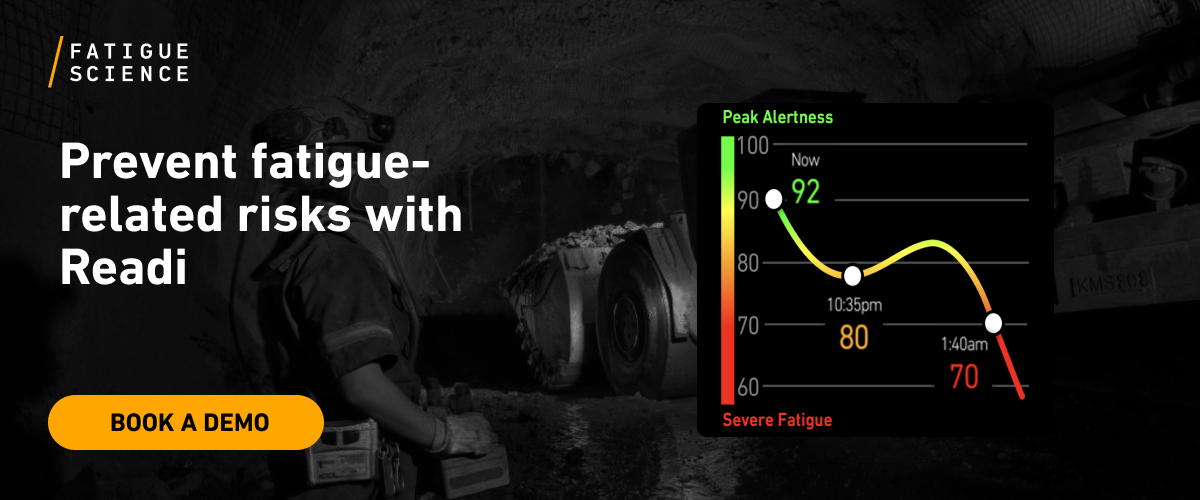



ELD data and driver safety go together when fleets use duty records to find recurring patterns and follow them with practical prevention steps.
See how Readi connects ELD data with personalized fatigue prediction
Key Takeaways
- Compare similar routes and operating periods.
- Treat data patterns as prompts for review, not proof of cause.
- Document the action, owner, and result.
- Readi adds an individualized forecast to existing safety context.
What ELD data contributes to safety
Electronic logging devices support accurate records of duty status and help carriers manage hours-of-service requirements. Depending on the system, fleets may also connect ELD data with vehicle or telematics records. For U.S. property-carrying drivers, the FMCSA HOS summary outlines common limits and rest provisions; exceptions and operating categories matter, so confirm the rule that applies to each operation.
ELD records answer questions about when work occurred. They do not verify sleep, measure readiness, or explain every safety event. Teams should distinguish compliance information from a complete assessment of risk.
Use the data to find patterns
Review start times, overnight work, route duration, consecutive demanding days, and the gaps between duty periods. A single day may look manageable while a repeated pattern creates limited recovery opportunity. Break down results by route, terminal, customer, and shift rather than comparing only fleet averages.
When appropriate, compare ELD timing with telematics events, camera reviews, coaching records, and incident reports. Check whether events cluster around a particular schedule or route. Treat a relationship as a reason to investigate, not proof that fatigue caused the event.
A broader fatigue risk management system helps connect findings to policies, roles, and action. Teams can also learn how ReadiScore works as one fatigue measure.
Move from reporting to prevention
Create response rules for elevated exposure. Dispatchers might adjust an assignment or start time; supervisors may check in, review circumstances, or arrange additional recovery. Keep ownership clear and record the reason for each action. Coaching should focus on schedules, route conditions, and practical choices available to the driver.
ELD records can support a more complete view when connected through ELD integrations and combined with driver fatigue management technology. Predictive analysis can give a supervisor another signal to review before dispatch, while cameras and telematics continue to provide information about events on the road.
Keep the program measurable and fair
Choose a small set of measures: recurring schedule patterns, response completion, fatigue-linked event trends, and operational changes made. Review them with safety and operations leaders. Explain how data is used, who can access it, and what decisions it can support. This builds trust and reduces the risk that an automated score is treated as a verdict about an individual.
From ELD insights to earlier action with Readi
ELD analysis can explain patterns in duty time and rest, while Readi by Fatigue Science adds a forecast of how fatigue risk may vary during an upcoming shift. This gives safety leaders a way to connect historical operational trends with a forward-looking view, then decide where a human review or planning conversation may be useful.
Readi is designed to support, not automate, safety decisions. Teams can use its forecast alongside route, telematics, and ELD context, apply their policy consistently, and record the actions taken. Explore how driver fatigue management technology can complement existing safety data.
Make safety insights actionable
Data is useful when teams agree on what happens next. Set a review cadence and define the patterns that warrant investigation, such as repeated late-night events on a route or a concentration of alerts after schedule changes. Look at denominators as well as counts: compare event rates across similar miles, shifts, and operating conditions. Check whether a change in reporting or system coverage affected the trend. Discuss findings with people closest to the work before drawing conclusions. Then assign an owner, a planned action, and a date to assess whether the action helped. Examples include reviewing a route plan, addressing a recurring delay, or offering a supervisor refresher. These steps help leaders distinguish a real improvement from a temporary fluctuation and communicate why a safety decision was made.
ELD data and driver safety: a framework for acting on insights
ELD data and driver safety: practical steps and decision criteria
For ELD data and driver safety, use the steps and review criteria in this guide to connect recorded work patterns, operational context, and fatigue prevention. Readi by Fatigue Science contributes a personalized forecast for the upcoming shift where deployed, supporting a contextual review by authorized supervisors.
Separate signal, context, and conclusion
ELD data can show that certain duty patterns repeat. It cannot establish on its own why they happen or whether a specific person is fatigued. A sound review has three stages: identify a signal, gather context, and decide whether a change is appropriate. Signals can include repeated overnight work, changing start times, compressed recovery, or events clustered at a similar point in a route. Context may include weather, customer dwell, road conditions, staffing, and driver feedback. Only after that review should the team decide what action to test.
Compare similar operating conditions and use rates as well as raw counts. For example, an event count should be interpreted with miles, route mix, and reporting coverage. Record the definition of each measure so teams do not compare unlike periods. Keep compliance and broader safety analysis distinct. Official FMCSA HOS information explains duty requirements, while NIOSH driver fatigue resources describe fatigue as a workplace safety concern.
Copy-and-use insight-to-action worksheet
- Signal: what repeated pattern or event prompted review?
- Scope: which routes, shifts, dates, and operating groups are included?
- Context: what do drivers, dispatch, and other records add?
- Decision: what operational change or follow-up will be tested?
- Owner and date: who will act and when will the team review progress?
- Measure: what leading and outcome indicators will be compared?
Share the outcome with the people who supplied the context. Closing the loop helps improve data quality and shows that reporting leads to practical learning.
Example: test a dispatch adjustment
If a group of events repeatedly occurs near the end of a night route, check whether dispatch time, traffic, and delay patterns are comparable. Discuss options with operations, choose a small scheduling change, and monitor both safety and service impact. Readi by Fatigue Science can add a personalized, forward-looking fatigue forecast for the upcoming shift, allowing authorized supervisors to consider forecast timing alongside ELD and route data. The forecast is one decision-support input, not proof of causation or a substitute for supervisor review.
Sources and further reading
Written by Fatigue Science, a provider of predictive fatigue risk management technology for fleet and industrial teams. Last updated: November 24, 2026.
ELD data and driver safety: practical review and action
ELD data and driver safety in day-to-day fleet operations
Begin by writing down the question the team needs to answer. driver safety should help identify a repeatable condition, not label an individual. Use a consistent review period and group records by comparable route, start time, terminal, and work sequence. Confirm that data are complete and that timestamps align before drawing comparisons. Ask drivers and dispatchers what shaped the work: routes with repeated events at similar points in the shift. Record this context with the evidence so another reviewer can understand how the team reached its decision.
A practical process distinguishes what the record shows from what it cannot show. An ELD documents duty status and driving history; it does not confirm sleep quality, alertness, or causation. Readi by Fatigue Science adds a personalized fatigue forecast across the upcoming shift where deployed. Together, ELD data and Readi can support a more complete planning discussion, with human review and company policy guiding each action. Keep access limited to authorized roles, explain how information is used, and give drivers a way to correct an inaccurate record or provide context.
| Review element | What to check | Possible next step |
|---|---|---|
| Work pattern | event clusters, exposure rates, data quality, and fair follow-up | Confirm whether the pattern repeats across comparable shifts. |
| Operating context | routes with repeated events at similar points in the shift | Discuss with the driver and operations before drawing a conclusion. |
| Forward planning | Upcoming schedule, forecast timing, route demands, and available response options. | Readi by Fatigue Science adds a personalized forward-looking fatigue forecast to existing fleet safety context. A team can consider the forecast with routes, ELD history, and telematics while planning a shift. The forecast does not establish why an incident happened; it supports earlier review and an operational response where appropriate. |
Copy-and-use review checklist
- Define: write the question, period, and operating group being reviewed.
- Verify: confirm the data are complete and comparable.
- Contextualize: check route, schedule, delays, and driver input.
- Decide: identify an owner and a policy-approved action.
- Document: record the evidence, decision, and follow-up date.
- Learn: review whether the pattern recurs and whether the control helped.
Use the checklist for prevention and continuous improvement, not automatic discipline. If the same condition affects several drivers, examine dispatch practices, route assumptions, staffing, or customer requirements. If the issue is isolated, confirm that the record is accurate and provide coaching or support suited to the circumstances. Readi by Fatigue Science adds a personalized forward-looking fatigue forecast to existing fleet safety context. A team can consider the forecast with routes, ELD history, and telematics while planning a shift. The forecast does not establish why an incident happened; it supports earlier review and an operational response where appropriate.
Example: Separate a signal from a conclusion and check context before intervention.
For example, if a review surfaces routes with repeated events at similar points in the shift, compare similar work periods, ask the people involved what changed, and identify whether a scheduling or process adjustment is possible. Set a time to check whether the new approach was followed and whether the pattern returned. Readi can help teams consider personalized fatigue risk timing before a shift, while ELD records describe prior duty patterns. Use the two sources as complementary context; neither replaces the driver’s report, applicable HOS rules, or a supervisor’s judgment.
Frequently asked questions
Do ELDs reduce driver fatigue?
They support HOS compliance and more reliable duty records. They do not directly measure sleep or alertness, so additional fatigue controls may be needed.
What should a fleet do with ELD patterns?
Use them to identify routes and schedules for review, compare with other safety data, and agree on practical actions with dispatch and supervisors.
What is the difference between compliance and a fatigue signal?
A compliance record describes recorded work against applicable rules. A fatigue signal suggests a condition worth examining and should be interpreted with context.