Product News

Safety-sensitive industries such as mining, transportation, energy, construction, and heavy manufacturing operate in environments where risk management is critical. Equipment failures, human fatigue, environmental hazards, and operational pressures can quickly lead to serious incidents if risks are not identified early.
In recent years, artificial intelligence (AI) has emerged as a powerful tool for improving risk management in these high-stakes environments. By analyzing large volumes of operational data, AI systems can detect patterns, predict hazards, and provide real-time alerts that help organizations prevent incidents before they occur.
This guide explains how AI is used in risk management, when organizations should deploy AI tools, the types of AI solutions available, and how to evaluate them effectively. It also explores the limitations of manual risk management approaches and why many organizations are shifting toward AI-driven safety strategies.
AI in risk management refers to the use of machine learning, predictive analytics, and automated data analysis to identify and mitigate operational risks.
Instead of relying solely on manual reporting or periodic reviews, AI systems continuously analyze large datasets to detect patterns that indicate potential safety hazards.
AI risk management systems can analyze data from multiple sources, including:
By combining these data streams, AI systems can predict potential risks and alert operators before incidents occur.
This predictive capability makes AI particularly valuable in safety-sensitive industries where even small mistakes can have serious consequences.
Traditional risk management approaches often rely on manual processes, historical reports, and periodic safety audits.
While these methods are useful, they have several limitations:
AI systems overcome these limitations by automating risk detection and analyzing complex data patterns at scale.
| Benefit | Description |
|---|---|
| Predictive risk detection | Identifies hazards before incidents occur |
| Real-time monitoring | Continuously evaluates safety conditions |
| Data integration | Combines multiple safety data sources |
| Faster decision making | Provides instant alerts and recommendations |
| Scalable safety management | Monitors large workforces and fleets |
These capabilities allow organizations to shift from reactive safety management to proactive risk prevention.
AI risk management tools are increasingly used across industries where operational risks can impact worker safety and business continuity.
| Industry | Example AI Risk Applications |
|---|---|
| Mining | Fatigue prediction, equipment monitoring |
| Transportation | Driver risk scoring, fatigue management |
| Energy | Asset monitoring and safety analytics |
| Construction | Hazard detection and site monitoring |
| Manufacturing | Equipment failure prediction |
Mining and transportation are particularly strong adopters because they involve long shifts, complex environments, and heavy machinery.
AI is not always necessary for every safety program. However, certain conditions make AI especially valuable.
Organizations should consider AI risk management tools when they face:
Monitoring hundreds or thousands of workers manually is difficult. AI systems allow organizations to scale safety oversight across large operations.
Industries like mining and transportation involve multiple variables such as weather, shift schedules, vehicle performance, and worker fatigue.
AI systems can analyze these variables simultaneously to identify emerging risks.
Operations involving heavy equipment, hazardous environments, or long driving hours require proactive safety management.
AI tools can help detect risk earlier than traditional reporting methods.
Organizations often collect vast amounts of data but struggle to extract meaningful insights.
AI systems can analyze this data quickly and identify patterns that would otherwise remain hidden.
AI risk management solutions fall into several categories depending on the type of risks they address.
Predictive analytics platforms use machine learning algorithms to identify patterns in historical data and estimate future risk levels.
These systems analyze variables such as:
Predictive models generate risk scores or probability estimates that help organizations prioritize safety interventions.
For example, a predictive system may identify drivers with elevated accident risk based on behavioral patterns.
Computer vision systems use AI-powered cameras and image analysis to monitor behavior and environmental hazards.
These systems are commonly used for:
In transportation, AI dash cameras can detect behaviors such as:
Computer vision allows organizations to monitor safety conditions in real time.
Fatigue is one of the most difficult safety risks to detect using traditional monitoring methods.
Fatigue risk can accumulate before workers even begin a shift, making it difficult to identify using behavioral monitoring alone.
AI-driven fatigue management systems analyze sleep patterns, schedules, and circadian rhythms to estimate fatigue risk.
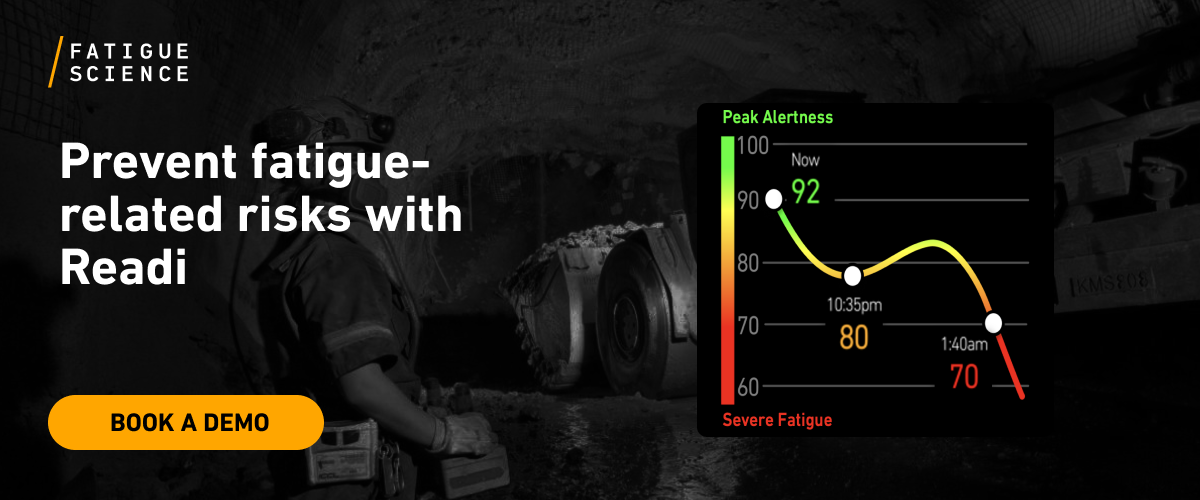
Readi is a fatigue risk management platform that uses biomathematical modeling and machine learning to estimate worker fatigue and cognitive effectiveness.
The system integrates sleep data and scheduling information to predict fatigue risk before safety-critical work begins.
Key capabilities include:
Readi is used across industries such as mining, transportation, and energy to help organizations manage fatigue risk proactively.
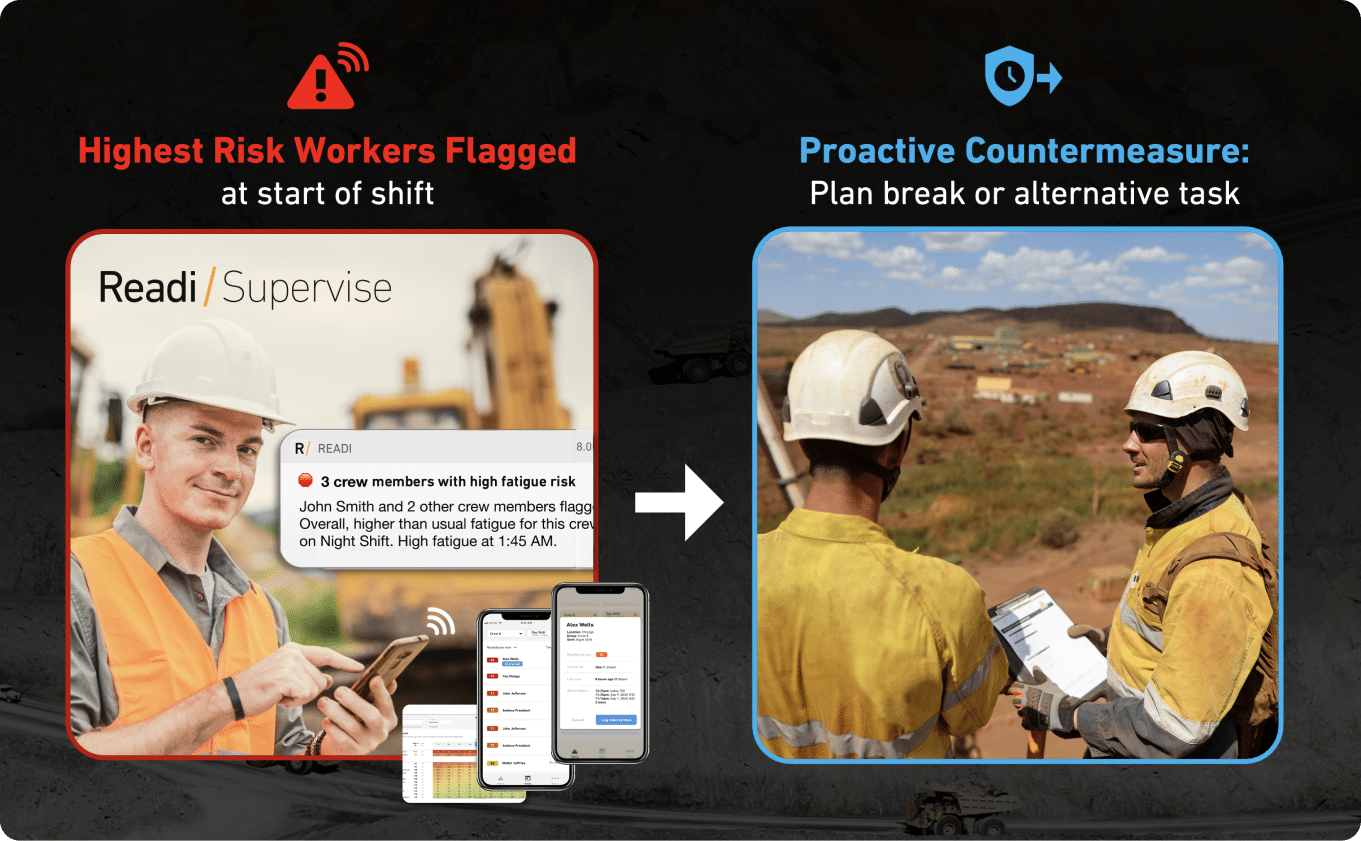
Unlike traditional fatigue detection tools, which attempt to detect fatigue after it appears, Readi focuses on predicting fatigue risk ahead of time.
This approach allows organizations to adjust schedules or reassign workers before fatigue impacts performance.
In industries such as mining and heavy transportation, equipment failures can create serious safety hazards.
AI-driven predictive maintenance systems analyze sensor data to identify early warning signs of equipment problems.
These systems monitor:
When abnormal patterns are detected, maintenance teams receive alerts before a failure occurs.
This helps prevent accidents and reduces costly downtime.
Organizations considering AI solutions for risk management should carefully evaluate available technologies.
Not all AI tools provide the same level of accuracy, transparency, or operational value.
| Evaluation Factor | What to Look For |
|---|---|
| Data sources | Ability to integrate multiple safety data streams |
| Predictive capability | Does the tool identify risk before incidents occur? |
| Transparency | Clear explanation of how risk scores are calculated |
| Accuracy | Evidence of validated models and real-world testing |
| Integration | Compatibility with existing safety systems |
| Privacy protection | Secure handling of worker data |
Organizations should also evaluate whether a tool provides actionable insights rather than just raw data.
Organizations adopting AI safety tools should follow structured implementation practices.
AI should support defined safety goals, such as reducing fatigue risk or improving driver behavior.
Combining multiple data streams improves AI accuracy.
These may include:
AI tools are most effective when safety teams understand how to interpret risk scores and alerts.
Training ensures that insights translate into real operational improvements.
AI models should be evaluated regularly to ensure they continue providing accurate insights as operational conditions change.
While manual risk management methods remain important, they have several limitations compared to AI-driven approaches.
| Limitation | Impact |
|---|---|
| Human bias | Risk assessments may be inconsistent |
| Limited data processing | Difficult to analyze large datasets |
| Reactive approach | Risks often identified after incidents |
| Delayed insights | Safety issues may go unnoticed for long periods |
| Advantage | Impact |
|---|---|
| Continuous monitoring | Detects risk in real time |
| Predictive insights | Identifies hazards before incidents occur |
| Data-driven decisions | Reduces reliance on subjective judgment |
| Scalable safety oversight | Monitors large operations efficiently |
AI does not replace human safety expertise, but it enhances decision making by providing deeper data insights.
Despite its benefits, implementing AI safety systems presents several challenges.
Common challenges include:
Organizations that address these issues through transparent communication and clear safety objectives often achieve the best results.
AI in risk management refers to the use of machine learning and data analytics to identify, predict, and mitigate operational risks.
Industries commonly using AI safety tools include:
AI systems can identify patterns and risk indicators that increase the likelihood of accidents, allowing organizations to intervene before incidents occur.
AI fatigue tools analyze sleep patterns, schedules, and circadian rhythms to estimate fatigue risk and alert organizations before safety-critical work begins.
AI is not a replacement for human safety expertise, but it can analyze large datasets and identify patterns that manual methods may miss.
The most effective safety programs combine AI insights with human decision making.
AI is transforming risk management in safety-sensitive industries such as mining and transportation.
By analyzing large volumes of operational data, AI systems can identify patterns, predict hazards, and provide real-time insights that help organizations prevent incidents before they occur.
Technologies such as predictive analytics, computer vision, and fatigue modeling are enabling organizations to move beyond reactive safety management toward predictive risk prevention.
Organizations that successfully integrate AI into their safety strategies often achieve improvements in:
As AI technology continues to evolve, it will play an increasingly important role in helping safety-critical industries manage risk and protect workers in complex operational environments.